
Are you feeling the pressure? The words artificial intelligence (AI) and automation are everywhere, promising unparalleled efficiency and competitive advantage. At the same time, Hungarian small and medium-sized enterprise (SME) managers often feel lost in a sea of technical jargon and over-promising. Their biggest fear is not the complexity of the technology, but falling behind, making a costly mistake or simply not knowing where to start.
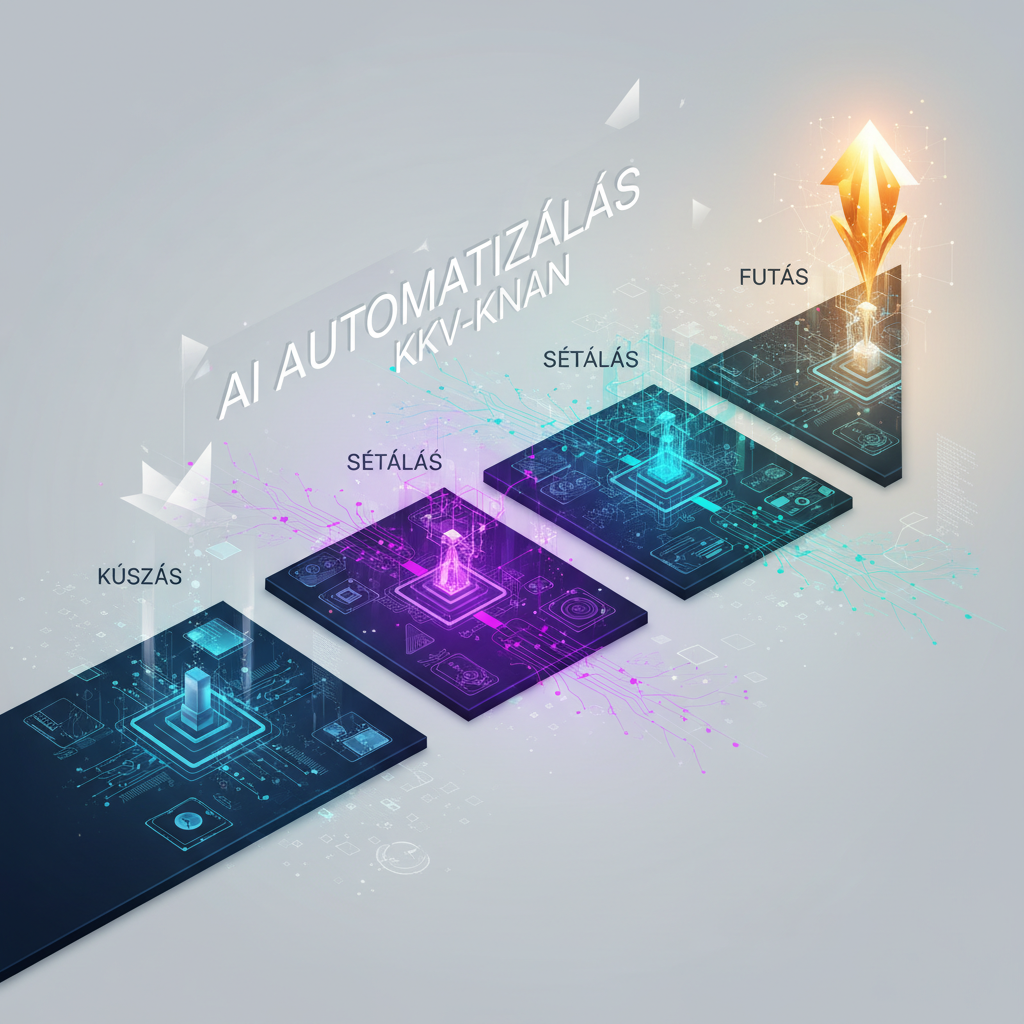
If this sounds familiar, you're in the right place. This article is not just another theoretical exercise. It is a practical guide tailored to Hungarian SMEs, taking you from theory to ROI. We present the "Crawl, Walk, Run" model, a simple, phased plan to safely and efficiently introduce AI automation into your business.
We will guide you through the following steps:
- Clear definitions: We clear up the confusion and explain in plain English what AI automation is and how it differs from traditional solutions.
- Balanced analysis: We will present the pros and cons honestly so you can make an informed decision.
- Step-by-step guide: Using the "Crawl, Walk, Run" model, we will show you how to start a small pilot project, how to roll it out and how to make it part of your corporate strategy.
- Practical toolkit: We offer a list of affordable and free AI tools to get you started right away.
Our aim is that by the end of this article, you will not only understand, but will have a concrete plan in your pocket for AI automation.
What is AI Automation? Dispelling the Confusion
Before embarking on the strategy, let's get the basics right. AI automation is much more than a simple, pre-programmed set of tasks. While traditional automation is based on rules - "IF this happens, THEN do that" - AI automation can learn, adapt and make decisions.
Think of traditional automation as a tram: it runs on a fixed track and does exactly what it was designed to do. In contrast, AI automation is like an experienced taxi driver: it knows the city, but if there's a traffic jam, it can plan a new route, take the weather into account, and make decisions based on its experience to reach its destination.
The table below helps you understand the main differences:
| Featured on | Conventional Automation | AI Automation |
|---|---|---|
| Operating principle | Pre-defined rules, fixed logic | Learning from data, pattern recognition |
| Type of task | Repetitive, structured, simple | Complex, changing, unstructured |
| Decision making | No, only implementation | Independent, predictive decision-making |
| Adaptation | Unable to adapt to change | Constantly learning and refining its operation |
| Example | Automatic e-mail reply in case of absence | Spam filter that detects new types of spam |
It is important to note that AI automation is currently in various stages of technological maturity. The "Hype Cycle" model from Gartner, a leading technology research firm, helps put new technologies into context, showing which are at the peak expectation, disillusionment or productive use phase [1]. Some elements of AI automation are already proven and widespread, while others are still in the experimental stage.
How AI Automation Works in Practice: the 'Sense, Think, Act' Model
To better understand how AI automation works, we use the "Sense, Think, Act" model. These three steps describe how AI transforms incoming information into intelligent action.
- Sense (Data entry): This is the phase where the system "senses" the world, i.e. collects data. This could be emails, customer queries in a chat window, images, numbers in a spreadsheet or even sensor data from a production line. The more and better quality data you have, the smarter the system will be.
- Thinking (AI Processing): This is where the magic happens. Artificial intelligence algorithms, such as machine learning or natural language processing (NLP), analyse the data received. They look for patterns, discover correlations and make predictions. For example, the system can "understand" the content and sentiment of an incoming email, or recognise that a customer issue requires urgent action.
- Actions (Automated Execution): Based on the analysis, the system performs an automated operation. This can be the automatic transmission of an invoice to accounting, the generation of a relevant response to the customer, the personalisation of a marketing campaign or the indication of a defective part on the production line.
We see this model in everyday life all the time. The recommendation system on Netflix or Spotify "senses" what we have watched or listened to (data), "thinks" about our habits and "acts" by suggesting new content that interests us. A modern spam filter works in the same way: it detects incoming mail, thinks about what might be unsolicited based on past experience, and acts by putting it in the spam folder.
Weighing up AI: Advantages, Disadvantages and Hidden Risks
Implementing AI automation is a major decision that requires careful consideration. As underlined by the Council of the European Union, AI can bring huge benefits to the economy and society, but it is also important to be aware of the potential risks and ethical issues [2]. Let's see the two sides!
The bright side of the coin: tangible benefits for your business
The right application of AI automation can bring dramatic improvements to an SME's operations. The benefits can be grouped into three main categories:
- Financial benefits: The most obvious is the cost reduction through automation. Automating repetitive, manual tasks (e.g. data entry, reporting, invoice processing) frees up manpower, reduces costs from errors and optimises resource use. According to widely cited research by McKinsey & Company, automation can reduce operational costs by up to 30% in some areas [3].
- Operational benefits: A increasing efficiency with AI is another key dividend. Systems work tirelessly 24 hours a day, speeding up processes and reducing lead times. Accuracy is improved because machines do not make errors due to inattention. For example, a local online store reduced customer service response times by 20% by implementing a simple AI chatbot, while allowing staff to focus on more complex issues.
- Strategic advantages: AI can analyse huge amounts of data and reveal patterns and trends that would be invisible to the human eye. This enables better, data-driven decision-making from marketing to product development. In addition, the personalised customer experience provided by AI will increase customer satisfaction and loyalty, which will provide a long-term competitive advantage.
Managing the Risks: the Most Common Pitfalls and How to Avoid Them
AI is not a panacea. There are a number of pitfalls in the implementation process, but the good news is that most of them can be avoided with conscious planning. Rather than just listing the "downsides of AI automation", we present a practical "Risk/Avoidance" table of solutions.
| Risk | Description | Prevention Strategy |
|---|---|---|
| High upfront costs and uncertain ROI | Software licences, implementation and expert fees can put a strain on SMEs' budgets. | Start small! Launch a low-cost pilot project. Use free or "freemium" tools to test the concept before making a major investment. |
| Excessive automation or automation in the wrong place | As the experts at xpert.digital warn, automating dysfunctional processes will only "speed up the chaos." [4]. Not all tasks are suitable for automation. | Process Suitability Checklist: Before you automate, ask yourself: is the process repetitive? Is it rule-based? Is it rule-based? Keeping tasks that require creativity or empathy (e.g. strategic planning, handling complex customer complaints) in human hands is key. |
| Privacy and security concerns | AI systems handle huge amounts of data, which raises the issue of GDPR compliance and data security. | Data protection from day one: Only choose a trusted provider that guarantees GDPR compliance. Anonymise data where possible and have an internal data management policy. |
| Algorithmic bias | If AI is trained on biased or incomplete data, its decisions will also be biased, which can lead to discriminatory results (e.g. in job advertisements). | Data quality and review: Make sure that your teaching data is representative and clean. Regularly check and test AI decisions and provide human review. |
| Worker resistance and fear | Employees may rightly fear that automation will take away their work, leading to resistance and project sabotage. | Open communication and retraining: He stresses that the aim is not to eliminate jobs but to get rid of monotonous tasks. Involve your team in the process and provide training on how to use new tools and perform higher value-added tasks. |
Practical Guide to AI Implementation: the 'Crawl, Walk, Run' Model
Now that we are clear about the basics, the benefits and the risks, let's move on to the most important question: how should a Hungarian SME start implementing AI automation? Recent research has shown that in Hungary there is a significant "implementation gap" between AI strategy and its practical application for economic benefit [5]. Our "Crawl, Walk, Run" model is designed to bridge this gap. It is a phased, low-risk approach that allows for learning and gradual progression.
Phase 1: Creep - Launching the First Pilot Project
The goal at this stage is not to change the world, but to achieve a quick, measurable success. Look for an area in your business that is low risk, but where successful automation will quickly deliver tangible benefits. This "quick win" will demonstrate the viability of the concept and build confidence to move forward.
They can be good pilot projects:
- Automation of internal reporting: Use an AI tool that automatically generates weekly marketing or sales reports from existing data.
- Timing of social media posts: A simple tool to automate the publishing of content across platforms.
- Answering common customer questions: Create a simple chatbot on your website that can answer the 10 most frequently asked questions instantly.
The key to success at this stage:
- Measurable targets: Set a clear target (e.g. "reduce reporting time by 2 hours per week").
- Simple ROI calculation: Estimate the expected return on investment. If a device costs 10 000 HUF per month, but saves 5 hours of work per month for a colleague with a 5 000 HUF hourly wage (25 000 HUF), the payback is clear.
Phase 2: Walking - Expanding to a Section and Training the Team
After a successful pilot project, it's time for the next step. Select an entire department or business function (e.g. customer service, marketing, inventory management) and explore how its processes can be optimised with AI.
At this stage it is already essential to change management. Staff involvement and training is critical. As hrportal.hu points out, one of the main reasons for employee resistance is ignorance and fear of the future [6].
Steps in this phase:
- Process exploration: Map the workflows of the selected department and identify automation opportunities.
- Involving a team: Talk to the staff! They know best what the most time-consuming, repetitive tasks are.
- Training and support: Organise internal training on the use of new tools. Designate an "AI champion" from the team to whom others can refer questions.
- Cultural change: Start building a company culture where AI is not the enemy, but a tool to help people focus on more creative, higher value-added work.
Phase 3: Run - Enterprise Level Integration and Strategic Advantage
This is the highest level, where AI automation is no longer an isolated project, but becomes an integral part of the corporate strategy. Automated systems from different departments are connected, sharing data and forming a single intelligent ecosystem.
Features of this phase:
- Data-driven decision-making: Management at all levels make strategic decisions based on real-time data analysed by AI.
- Continuous optimisation: The company is constantly looking for new automation opportunities and refining existing systems.
- Competitive advantage: The efficiency, speed and customisation provided by AI creates a level of competitive advantage that is difficult for competitors to match.
At this level, a dedicated expert or external consultant is often needed to help integrate complex systems and develop a long-term AI strategy. Large enterprise software companies such as Microsoft or SAP have extensive resources to support this level of integration [7].
The Hungarian SME AI Toolkit: free and affordable solutions
The biggest misconception about AI is that it's only available to large companies. Today, there are plenty of free and affordable tools that any SME can use to get started. The list below is not a complete, bulk collection, but a curated "SME Startup Kit", grouped by function.
Marketing and Content Production
These tools help you create blog articles, social media posts, ad copy and images faster and more efficiently.
- ChatGPT / Microsoft Copilot: Writing, brainstorming, drafting emails, writing summaries. The free version of Copilot meets the needs of most SMEs. Best for this: Quick text generation and brainstorming for solo entrepreneurs and small teams.
- Canva Magic Studio: AI-based image editing and generation features within a popular and easy-to-use graphics platform. It helps you create social media graphics, presentations and other visual materials. Best for this: Quickly create visual content for marketers who are not graphic designers.
- Copy.ai / Jasper: Platforms specifically dedicated to writing marketing texts (ads, product descriptions, blog posts). Hungarian language support is variable but improving. Best for this: Production of large volumes of marketing text based on templates.
The table below helps you compare the most popular content generation tools:
| Tool | Price (approx.) | Main function | Hungarian language support |
|---|---|---|---|
| ChatGPT (GPT-4o) | Free / Plus: ~$20/month | General text and code generation | Excellent |
| Canva Magic Studio | Free / Pro: ~4000 HUF/month | Visual content generation | Good |
| Copy.ai | Free / Pro: ~$36/month | Marketing copywriting | Medium-Good |
As national AI marketing agencies point out, these tools are not a substitute for strategic thinking, but they can be a huge help in implementation [8]. At Hendeweb, for example, we use ChatGPT and Copilot to speed up the research phase and produce first versions of article drafts.
Customer Service and Communication
These tools help to answer customer queries quickly and automate communication processes.
- Tidio / Crisp: Easy to install chatbots on websites. Free versions can also answer common questions and collect visitor data. Case studies show that a well-configured chatbot can reduce the time spent on simple, repetitive questions by up to 90%. Best for this: Immediate response to website visitors, even outside working hours.
- Gmail / Outlook built-in features: Features such as "Smart Reply" or email templates are small but effective automation steps that save minutes a day. Best for this: Speed up individual email communication.
Operations and Project Management
These tools make internal operations more efficient.
- Asana / Trello / Notion AI: Popular project management tools have more and more built-in AI features. They can automatically summarise meetings, suggest next steps, or even generate complete project plans based on a simple description. Best for this: Reduce project administration and increase the efficiency of teamwork.
- Zapier / Make: These "integration platforms" allow you to connect different software that do not communicate with each other. For example, you can set up an automation to automatically create a task on the Trello board and a notification in the Slack channel for each new online order. Best for this: Combining different free or low-cost tools into a single workflow.
The Hungarian Context: Strategy, Support and Opportunities
AI automation is an international trend, but to successfully implement it, it is essential to understand the local context. Hungary has recognised the importance of AI and has developed a formal strategy for its deployment.
The main objective of Hungary's Artificial Intelligence Strategy (2020-2030) is to focus AI development and applications on sectors with the highest growth potential. Examples include manufacturing, health, agriculture, transport and logistics [9]. If your business operates in one of these industries, you can expect to benefit from targeted support and programmes in the future. Read the full document here: Official MI Strategy of Hungary (2020-2030).
The European Union is also actively supporting the digital switchover of SMEs. Programmes such as the Project BrAIn or the European Digital Innovation Hubs (EDIH) network, providing concrete assistance: resources, advice and training to help businesses adopt AI [10]. It is worth monitoring these options as they can significantly ease the financial burden of implementation. The European Commission's synthesis report on Hungary's strategy provides further insights into the alignment of national and EU objectives: European Commission Report on Hungary's MI Strategy.
Summary: Your Roadmap to the Future
AI automation is no longer a science fiction promise of the distant future, but a tangible reality of the present, available and necessary for Hungarian SMEs to remain competitive. The key to success is not a huge, immediate investment, but a conscious, step-by-step approach.
The "Climb, Walk, Run" model gives you a safe and proven framework. Start with a small, measurable project, learn from the experience, get your team involved and gradually expand automation to other areas of your business.
With this guide, you'll no longer just know AI automation in theory, but have a practical plan to take you from the first steps to a measurable return on investment.
Don't be left behind in the race! Start implementing AI automation today with the "Crawl" phase. Download our free "AI Implementation Project Plan" template and take the first step towards more efficient operations! And if you need personalized assistance, contact us.
This article is for information purposes only and does not constitute business or financial advice. Always conduct your own research and consult an expert if necessary before implementing AI tools. The results achieved may vary from company to company.
Sources and References
- Gartner, Inc (N.D.). Gartner Hype Cycle. Gartner. Retrieved from https://www.gartner.com/en/research/methodologies/gartner-hype-cycle
- Council of the European Union (2021). The benefits and risks of artificial intelligence. Consilium.europa.eu. Retrieved from https://www.consilium.europa.eu/hu/policies/benefits-and-risks-of-ai/
- McKinsey & Company. (N.D.). Automation and the future of work. McKinsey & Company. (The 30% figure is a widely cited general finding on automation potential published by McKinsey.)
- xpert.digital. (N.D.). The AI paradox: Why not automate everything?. xpert.digital. Retrieved from https://xpert.digital/hu/a-ki-paradoxon/
- Farkas, G., & Szabó, Z. (2024). Hungary and AI: efforts and opportunities in comparison with a leading country's strategy. arXiv. Retrieved from https://arxiv.org/pdf/2407.05280
- HR Portal. (2024). AI-mindset: from resistance to efficiency. hrportal.hu. Retrieved from https://www.hrportal.hu/hr/ai-mindset-ellenallastol-a-hatekonysagig-20240829.html
- SAP. (N.D.). What Is Intelligent Automation?. SAP. Retrieved from https://www.sap.com/hungary/resources/what-is-intelligent-automation
- AI Marketing Agency. (N.D.). Artificial intelligence tools for small businesses. aimarketingugynokseg.hu. Retrieved from https://aimarketingugynokseg.hu/mesterseges-intelligencia-eszkozok-kisvallalkozasoknak/
- Ministry for Innovation and Technology, Hungary. (2020). Hungary's Artificial Intelligence Strategy 2020-2030. Kormany.hu / AI Watch, European Commission. Retrieved from https://ai-watch.ec.europa.eu/countries/hungary/hungary-ai-strategy-report_en
- Interreg Danube Region Programme (N.D.). BRinging Artificial INtelligence towards SMEs (Project BrAIn) - State of the Art in AI. Interreg Danube. Retrieved from https://interreg-danube.eu/storage/media/01JKCX6K0Q3R9WTV7A3RAC4PPX.pdf

 English (UK)
  Magyar
  Deutsch
  Русский
  简体中文
简体中文
Leave A Comment